
Specter Labs / Artificial life
Lenia
Swarm
What makes a pattern a body?
Shape, development, and the rules that keep matter moving.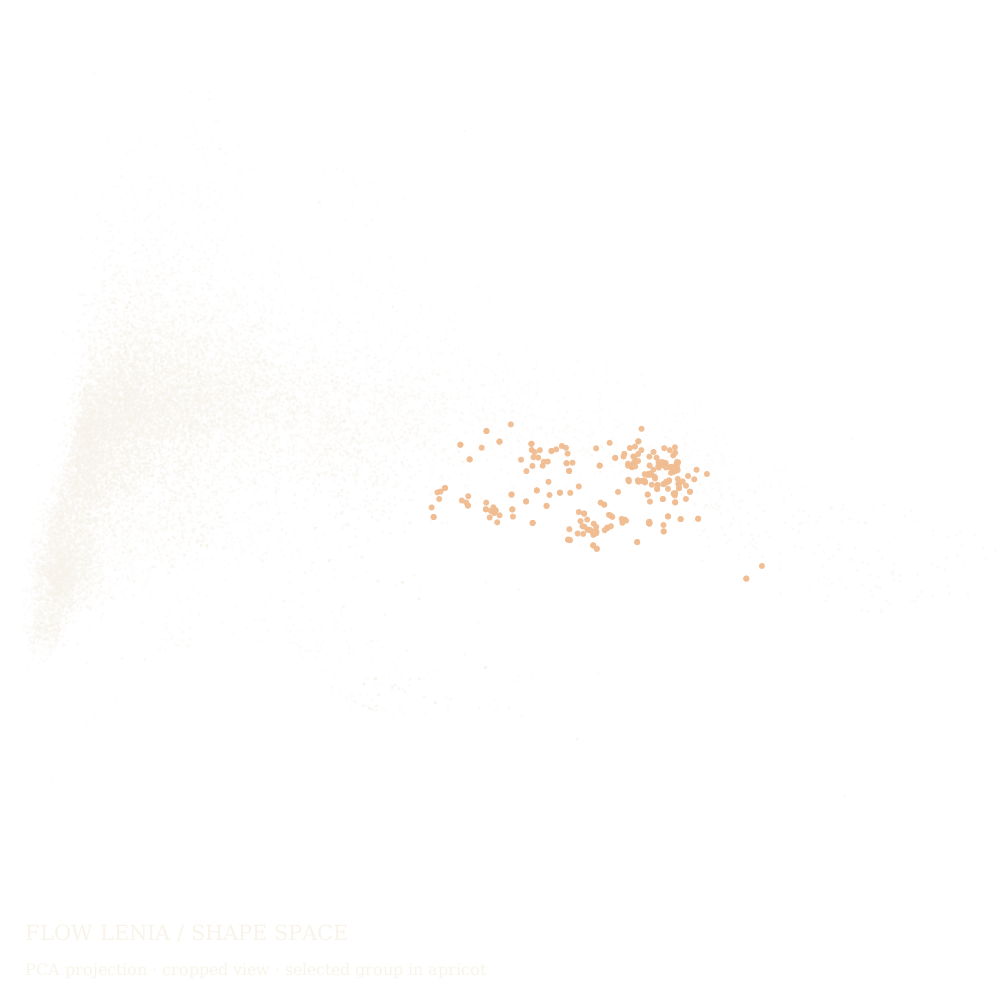
Flow Lenia’s local rules move matter across a grid, sometimes producing bodies that hold together as they move and sometimes patterns that break apart. Saving a state lets us replay either outcome under changed conditions, so that we can investigate what sustains the body and which changes send its development in another direction.
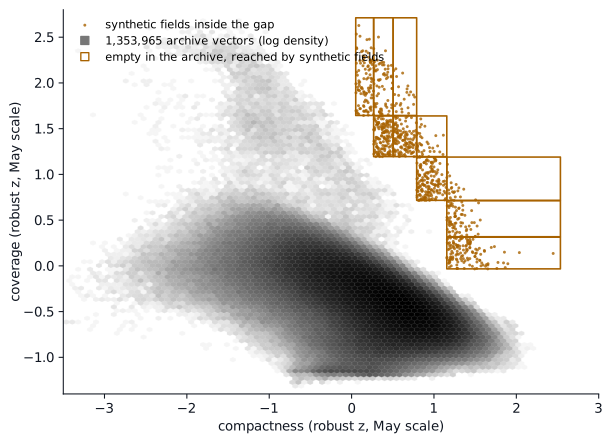
Where Flow Lenia bodies go in shape space
Twelve shape measurements place 25,167 Flow Lenia bodies in a cloud with about three effective directions. Most of its empty regions come from the measurement or from undersampling, while one band of centrally peaked bodies that still fill their footprint stays empty across 1.35 million archived bodies, and a registered search will test whether the dynamics can reach it.
Recovering the rule behind a Lenia body
We give a search a complete body or an observation from a known rule family. Maintaining a supplied body does not yet solve how to grow it, and an Orbium reconstruction shows what becomes possible when the rule family and starting cells are known.
Obstacle Responses in Coherent Flow Lenia Bodies
Five temporally consistent, coherent movers completed fifteen matched obstacle encounters. All retained their matter, but their motion and organization changed in different ways: bending, arrest, reversal, and loss of coherence.
Causal emergence in developing bodies
We are also asking whether a developing Flow Lenia body comes to behave as a whole, in the sense that a description of the whole body predicts and steers its future better than descriptions of its parts, and whether that organization appears before the body settles into a coherent form. The measurements so far are preliminary, because they depend on how the field is divided into parts and on which information estimator is used, and we are re-testing them across those choices for robustness before we report a result.
Compendium Inspector
Browse selected published releases, inspect the recorded shape and motion measurements, and open a specimen’s replay configuration. These galleries are selections from the broader archive; they are not the complete cohort used in the morphospace analysis.
Tools for reproducing the experiments
The system is a controller-worker topology over a SWIM gossip cluster, with an MLX Swift engine for GPU-accelerated Flow Lenia across Apple machines, split into three components:
LeniaCore: physics engine, distributed actors, search infrastructure.LeniaCLI: headless workflows underdiscover,orchestrate,index,analyze,intervene,publish.LeniaStudio: macOS SwiftUI app for local exploration, host mode, and worker mode.